
MORDOVIA-IOT
Сошёл с орбиты NORAD 61765 GAHV-9088-5977-7290-0624 R4UAB Russia
Soyuz 2.1b Fregat-M
Ракета-носитель
Cosmodrome Site 1S
Космодром
5290
Наблюдений за всё время
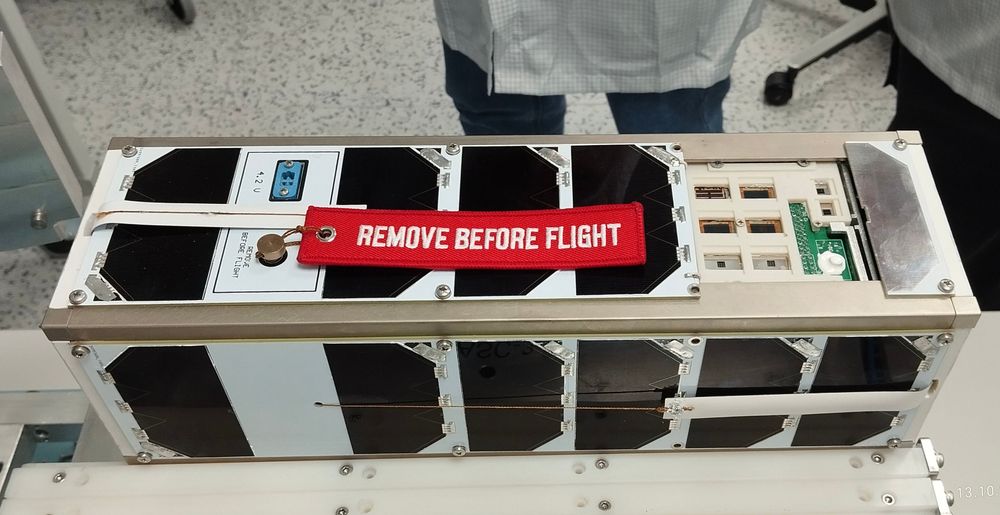
Amateur radio satellite for IoT (Internet of Things) technology experiments and for testing perovskite solar cells.
The Mordovia-IoT spacecraft (State Budgetary Professional Educational Institution of the Republic of Mordovia Saransk Polytechnic College) has an IoT (Internet of Things) module developed by schoolchildren. Payloads IoT module (Internet of Things); low resolution camera (FSK/SSTV); module for testing perovskite solar cells. The technology allows, using IoT satellite communications, to receive information from ground-based educational sensors (weather stations, environmental monitoring systems, water level sensors, smart agricultural sensors, SOS signals) and retransmit them back to Earth or store them in the spacecraft's memory for subsequent reset to Earth. In addition to receiving data from ground-based systems using satellite communications, it is planned to test the control of remote ground-based devices via satellite. Description of the IoT satellite relay mission: creation of space infrastructure to support Russian IoT networks. Satellite relay will allow connecting IoT devices in remote and hard-to-reach regions of the Earth where there is no traditional communication infrastructure, including deserts, oceans, mountains and rural areas. The functions of the IoT repeater module are to receive signals from multiple IoT devices on Earth. After receiving the data, the module transmits it to ground stations for further processing and analysis. The module can partially process the data, for example, filter out important signals or aggregate information before transmitting it. Application: Agriculture and environmental monitoring: The satellite-supported IoT system can monitor field conditions, control water levels, soil moisture and other parameters in real time, ensuring timely crop care actions; Transport and logistics: The IoT module on the satellite helps track vehicles, ships and aircraft around the world, ensuring continuous communication even in the most remote places; Industrial projects: Devices such as oil platforms, mining stations and other objects located in remote areas can transmit data about their operations via an IoT network on a satellite; Ensuring security and disaster management: The IoT satellite communication system can support disaster monitoring, detect hazardous material leaks, and transmit important data in real time. Advantages: global coverage: connecting IoT devices anywhere on Earth; independence from ground infrastructure: there is no need to build cell towers or lay cables, which is especially important in hard-to-reach places; Low latency and high reliability: Modern satellite systems provide high data transfer rates and reliable connections, which is critical for some IoT services. It uses energy-efficient protocols to transmit small data packets, which is in line with the characteristics of most IoT devices that frequently send short messages. Thus, the IoT relay module on the satellite will provide global communication for Internet of Things devices, which will open up new opportunities for commercial, scientific and government projects in the most remote regions of the world. The Mordovia-IoT satellite will operate according to two schemes: data transmission without information processing and data transmission with information processing. Data transmission without processing : the subscriber (device) on Earth receives a communication channel with the satellite, the satellite at that moment establishes a connection with the base station on Earth, and the subscriber (device) directly retransmits the data to a server on the Internet or to a school receiving station. Data transmission with processing : the subscriber (device) on Earth receives a communication channel with the satellite and all transmitted information from the subscriber (device) is stored in the internal memory of the satellite and then sent to the base station on Earth and published on the Internet. This method of data transmission is possible in hard-to-reach places on planet Earth. Such a system is relevant in the territory of the Russian Federation, where only 20% of the territory has access to communication systems. Access to the satellite channel will be open to everyone. This will allow a schoolchild to install a weather station with sensors in a remote location, and then receive data from it using space communications and monitor the state of the environment in an educational institution or at home.
Спутник сгорел в атмосфере












1 61765U 24199AG  26036.19443600  .16377816  26719-5  36725-3 0  9999
2 61765  97.2739 278.4782 0007770 210.1809 149.9048 16.46150586114513

Средние элементы каждого набора TLE за последние 365 дней, по оси времени — эпоха набора. Каждый источник — своя линия, щелчок по легенде скрывает её. Скачок высоты — манёвр или ошибочный набор, расхождение линий — разница между источниками. «Возраст TLE» — сколько часов прошло от эпохи самого свежего набора источника, по оси времени — момент, когда набор пришёл к нам, шкала логарифмическая. Набор, который источник повторил без изменений, возраст не сбрасывает.
Каждый набор TLE продолжен моделью SGP4 до эпохи следующего набора того же источника и сравнён с ним, по оси времени — эпоха следующего набора, в подсказке — на сколько часов вперёд был прогноз. Шкала логарифмическая и показывает размер расхождения, знак — в подсказке: плюс вдоль орбиты — прогноз впереди спутника. Это согласованность наборов, а не истинная ошибка: эталон — тоже TLE с ошибкой порядка километра. Выброс — манёвр между наборами. Наборы дальше недели друг от друга не сравниваются.